


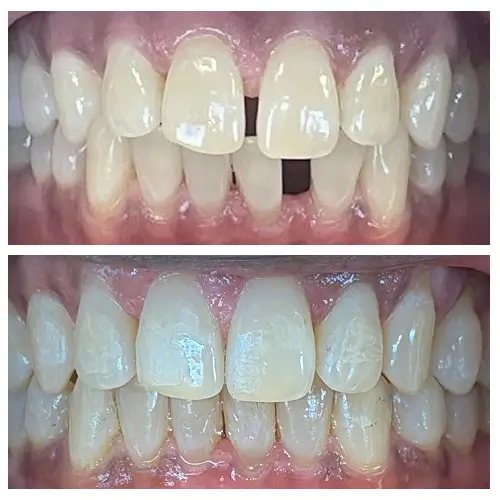


Can Invisalign bring a tooth down?

Invisalign, a groundbreaking approach to orthodontic treatment, has definitely transformed how we think about braces. Known for its discretion and comfort, Invisalign has become a preferred choice for many seeking to improve their smile. In our dental clinic in Laurel, MD (20707), we often encounter questions about the extent of Invisalign’s capabilities, mainly whether it can effectively move a tooth downwards, a process known as tooth extrusion. This article highlights the intricacies of using Invisalign for tooth extrusion, comparing it with traditional braces and discussing the factors influencing treatment duration.

Why Invisalign Leads the Clear Aligner Field

What makes Invisalign the standout name in clear aligner treatments? Experience and innovation take center stage. Since its debut in 1997, Invisalign has been at the forefront of orthodontic technology, investing extensively in research and development to understand how teeth move and how best to guide them into place.

With over six million successful cases worldwide, Invisalign’s vast data pool has enabled them to fine-tune every aspect of their system, ensuring predictable, effective results for a variety of dental needs. This ongoing commitment to improvement means the aligners you’re wearing today benefit from decades of scientific insight and technological advancement.

Unlike newer entrants to the market, Invisalign’s early start has allowed them to test, adapt, and perfect their approach—giving patients confidence in both the process and the results. In short, their leadership in the field is well-earned, offering peace of mind for those considering clear aligners for their orthodontic journey.

Can Invisalign Move a Tooth Downwards?

Yes, Invisalign can move a tooth downwards. Invisalign functions through a series of custom-made, clear aligners that apply controlled force to teeth, gradually shifting them into the desired position. This process includes extrusion, where a tooth is moved downward to align with the other teeth. The success of this movement depends on the complexity of the case and the patient’s specific orthodontic needs.

What Is the Periodontal Ligament and Why Is It Important for Tooth Movement?

To truly appreciate how Invisalign can bring a tooth down, it helps to understand the key biological player behind tooth movement: the periodontal ligament. Think of the periodontal ligament as a tiny, flexible cushion nestled between each tooth root and the surrounding bone. It acts as a shock absorber, holding the tooth in place while still allowing for subtle movement—about 2mm if you gently wiggle a tooth.

But its real claim to fame lies in its role during orthodontic treatment. When Invisalign aligners apply pressure to a tooth, the periodontal ligament springs into action. Specialized cells within the ligament coordinate the remodeling of the surrounding bone—some cells break down the bone in the direction the tooth is moving, while others help build new bone in the space left behind. This delicate balance is what allows your teeth to gradually shift into their new positions.

It’s also quite normal for your teeth to feel slightly loose during treatment; this is simply a sign that your periodontal ligament and bone are actively adapting. Once your teeth reach their ideal alignment, your bone needs a bit more time to fully stabilize around each tooth. That’s why diligent retainer use after Invisalign is essential—to help your bone and ligament settle and to maintain your new smile.

What Is a Clincheck and How Does It Relate to Invisalign Treatment?

Before your Invisalign journey officially begins, there’s a vital digital step known as the Clincheck.

Think of it as the blueprint for your new smile. Here at our dental clinic in Laurel, MD, we start with detailed X-rays and digital scans or impressions of your teeth to capture their exact positions. From there, Clincheck steps in: it’s advanced computer software that generates a 3D simulation of your teeth’s movements, right from start to finish.

Using this digital preview, both you and your orthodontist can see the projected outcome of your treatment—down to the tiniest tooth movement. This allows you to visualize how your smile will change, and make sure you’re happy with the plan before any aligners are produced. Once the digital plan is approved, the aligners are custom-manufactured, and your treatment begins, following that precise roadmap for your best smile.

How Does Invisalign Facilitate Tooth Extrusion?

Invisalign facilitates tooth extrusion by applying consistent, targeted pressure on the tooth that needs to be moved. The aligners are designed based on a digital plan that maps out the entire treatment, allowing precise control over the force applied to each tooth.

The process begins with a comprehensive evaluation, including X-rays and either dental impressions or digital scans, to capture the exact starting positions of your teeth. Using this information, your orthodontist creates a detailed digital treatment simulation—often called a “ClinCheck”—that shows the projected movement of your teeth and the anticipated end result. This virtual roadmap ensures that each aligner in your series is custom-made to guide your teeth, step by step, toward their ideal positions.

Once the digital plan is finalized and you’re happy with the proposed outcome, your aligners are manufactured and shipped directly to your provider. Each set of aligners is carefully calibrated to deliver just the right amount of force, which is crucial for more complex movements like extrusion. This level of customization ensures that tooth movement is both precise and predictable, helping Invisalign achieve results similar to traditional braces, but with added discretion and comfort. For extrusion cases, special features like attachments or buttons may be used alongside the aligners to provide additional grip and direction of force.

How Does Bone Remodeling Work During Invisalign Treatment?

To understand how Invisalign moves teeth—especially when bringing one down—it helps to peek behind the scenes at what’s happening in your mouth. Your teeth might seem solidly anchored in place, but they’re actually held in position by a flexible network called the periodontal ligament. This ligament acts as a tiny shock absorber between your tooth root and the jawbone.

When Invisalign aligners apply gentle, directed pressure to a tooth, they send signals to your body to begin a fascinating process: bone remodeling. Here’s what happens step-by-step:

  • Pressure Side: The aligner’s force prompts bone cells (osteoclasts) to gradually dissolve bone in the direction the tooth is moving, making space for the tooth’s new position.
  • Tension Side: Simultaneously, on the opposite side, other bone cells (osteoblasts) start filling in the space where the tooth used to be with fresh bone tissue.

This incredibly coordinated process allows for safe, controlled tooth movement over time. You might notice your teeth feel a bit loose during treatment—this is completely normal and just means the bone is actively remodeling.

It’s important to wear your retainers as directed once treatment ends. After the aligners have finished their job, the bone surrounding your teeth needs time to firm up and secure your beautiful new smile in place.

What is IPR (Interproximal Reduction) and Why is it Used in Invisalign Treatment?

Interproximal Reduction, or IPR, is a common technique used during Invisalign treatment to help create space between teeth. Essentially, it involves carefully reshaping or polishing the sides of selected teeth. This process is especially helpful in cases where there is dental crowding and not enough room to straighten teeth effectively.

By gently reducing the width of certain teeth, your orthodontist can make room for teeth to move into better alignment. It’s a minimally invasive method that preserves tooth health while optimizing your Invisalign results. IPR is often performed in-office, using precision tools to ensure both safety and comfort. It can be essential for achieving an even, well-aligned smile, particularly when traditional extractions aren’t necessary or desirable.

What is the Process for Starting Invisalign Treatment?

The journey toward a straighter smile with Invisalign begins with a comprehensive consultation at your dental office. During this initial visit, your dentist will carefully evaluate your teeth and bite alignment—often using digital scans, photographs, and X-rays—to determine whether Invisalign is the right solution for your specific needs.

If you’re a good candidate, your dentist will proceed by capturing detailed digital impressions or molds of your teeth. These records serve as the foundation for your personalized treatment plan.

Using advanced software, your dentist will create a virtual model of your treatment, showing the projected movement of each tooth and previewing your future smile. Once you’re satisfied with the proposed results, your custom aligners are ordered—crafted precisely for your mouth.

Generally, it takes around two weeks for the aligners to arrive from the manufacturer (Invisalign aligners are made by Align Technology, a widely trusted brand in clear aligners). When your aligners are ready, you’ll return to the clinic for your fitting appointment. At this stage, your dentist may place small tooth-colored attachments or perform minor adjustments, such as interproximal reduction (IPR), to help the aligners work more effectively.

You’ll be given detailed instructions on how to wear your aligners—typically 22 hours per day, only removing them for eating, drinking, brushing, and flossing. Most patients switch to a new set of aligners every one to two weeks, according to the plan your dentist provides.

Throughout your Invisalign journey, you’ll have periodic check-ups so your progress can be monitored and any necessary adjustments can be made. Sometimes, extra sets of aligners, known as refinement aligners, are needed to achieve the best possible result. But rest assured, refinements are a normal part of treatment for many patients.

Once your treatment is complete and you’re delighted with your new smile, you’ll transition to wearing retainers. These help maintain your results, ensuring your teeth stay beautifully aligned.

When Is It Necessary to Bring a Tooth Down with Invisalign?

Bringing a tooth down with Invisalign may be necessary in several scenarios, such as when a tooth is positioned higher than the rest, impacting the bite and overall aesthetics of the smile. This situation can occur due to genetics, delayed eruption, or losing a primary tooth too early. Correcting such alignment issues is crucial for cosmetic reasons and improving oral function and health.

Invisalign is a versatile solution capable of addressing a wide range of orthodontic concerns beyond just extrusion. Whether you’re dealing with crooked teeth, crowding, gaps, overbites, underbites, crossbites, or open bites, Invisalign’s custom-made aligners can help move your teeth into better alignment when used as prescribed. Success with Invisalign largely depends on following your treatment plan consistently. When worn as directed, these aligners offer an effective path to a straighter, healthier, and more confident smile.

What’s the difference between Invisalign and traditional braces for tooth Extraction?

The critical difference between Invisalign and traditional braces for tooth extrusion lies in the method of applying force. While Invisalign uses a series of removable aligners, traditional braces use fixed brackets and wires to move teeth. Invisalign serves as a more aesthetic and comfortable solution, allowing easy removal during eating and dental care. However, traditional braces might be recommended in more complex extrusion cases requiring greater force or precise control.

How Does Invisalign Compare in Speed to Traditional Orthodontic Braces?

When it comes to treatment speed, Invisalign can often achieve tooth movements—like extrusion—within a relatively short timeframe compared to traditional braces, especially for straightforward cases. The aligners are precisely engineered to move your teeth incrementally, with each set designed to make gradual changes, typically shifting teeth about 0.25 mm per tray. With aligner changes as frequently as every week, noticeable progress can occur within just a few months.

In contrast, traditional braces can sometimes require a longer treatment period, particularly for mild-to-moderate adjustments. This is partly due to the interval between orthodontic visits and the complexity of manual adjustments needed. Invisalign’s digital planning and predictable force application may expedite simpler cases, making it an appealing option for patients seeking efficiency and convenience—provided they stay diligent about wearing their aligners as prescribed.

Of course, for more complex tooth movements or severe misalignments, traditional braces may still have the edge in delivering optimal results, albeit over a longer treatment timeline.

How Long Does It Usually Take for Invisalign to Bring a Tooth Down?

The duration of Invisalign treatment to bring a tooth down varies depending on the individual case’s complexity. Generally, minor tooth movements can be achieved within a few months, while more significant adjustments may take up to a year or more. Consistently wearing aligners for 20-22 hours per day is crucial to stay on track with the projected treatment timeline.

It’s also worth noting that sometimes, even after reaching your last aligner, your teeth might not be perfectly aligned as initially planned. This is quite common and nothing to worry about. In such cases, your orthodontist may recommend a “refinement” stage, which involves additional sets of aligners to fine-tune your results until your teeth reach their ideal position.

Once your treatment goals are achieved and your teeth are in their new positions, you’ll need to wear retainers. These are essential for maintaining your results and preventing your teeth from shifting back to their original positions.

How Often Do You Need to Change Invisalign Aligners?

Patients typically switch to a new set of Invisalign aligners every one to two weeks, as directed by their orthodontist or dentist. Each set should be worn for 20–22 hours daily, only being removed to eat, drink, brush, or floss. Sticking to this schedule ensures steady and predictable progress, helping move your teeth efficiently according to your treatment plan. The more consistently you wear your aligners, the more effectively your teeth will respond to each stage of movement.

What Factors Affect the Duration of Invisalign Treatment for Tooth Extrusion?

Several factors can affect the duration of Invisalign treatment for tooth extrusion, including the extent of movement required, the patient’s age and overall dental health, and how consistently the aligners are worn. Additionally, patient adherence to scheduled check-ups and following the orthodontist’s instructions play a critical role in the success and timing of the treatment.

What Happens If Teeth Aren’t Perfectly Straight After Finishing the Initial Aligners?

It’s not uncommon for teeth to be slightly out of alignment after completing your first set of Invisalign aligners. If this happens, there’s no need for concern—your orthodontist can initiate a “refinement” phase. This means a new set of aligners will be custom-made to address any remaining movement needed for that perfectly aligned smile.

Refinement phases are a standard part of the Invisalign process and are included in your treatment plan at no additional charge. Your progress will be re-evaluated, and updated digital impressions or scans will be used to design new aligners tailored to your needs. This extra step ensures you achieve the optimal result and are fully satisfied with your smile transformation.

If you’re thinking about starting Invisalign, it’s helpful to know what the treatment journey looks like from start to finish. Here’s a simple breakdown of what you can anticipate in our Laurel dental office:

The Invisalign Journey: Step by Step

  • Initial Consultation: Your Invisalign experience begins with a thorough consultation. During this visit, your dentist evaluates whether Invisalign is right for you—they’ll review your dental history, examine your teeth, and may take digital scans, photographs, or X-rays. This is also a great moment to ask any lingering questions about the process.
  • Personalized Treatment Planning: If you’re a good candidate, your dentist uses your dental scans to create a detailed digital treatment plan. This plan maps out every stage of your tooth movement, often giving you a sneak preview of your future smile before treatment begins.
  • Receiving Your Aligners: Once you’ve approved the plan, a series of custom-made, clear aligners are ordered. They typically arrive within a couple of weeks, and you’ll be invited back to the office for the fitting. In some cases, your dentist may place small, tooth-colored attachments or may recommend minor enamel adjustments (IPR) to help the aligners work more effectively.
  • Wearing Your Aligners: You’ll wear each set of aligners for 20–22 hours a day, switching to the next set every 1–2 weeks according to your customized plan. Aligners should only be removed for eating, drinking (other than water), and oral hygiene. The more consistently you wear them, the more efficiently your teeth will move.
  • Progress and Adjustments: Throughout treatment, you’ll have periodic check-ins so your dentist can monitor progress and make any necessary adjustments. If teeth don’t move precisely as planned, you might go through a “refinement” phase—this means additional aligners may be made to perfect your results. Don’t worry, refinements are a common part of Invisalign treatment.

After Invisalign: What Happens Next?

Once your teeth have reached their final, beautifully aligned positions, it’s time to ensure your results last. You’ll receive custom retainers designed to keep your teeth in place and prevent them from slipping back to their old positions. Wearing retainers as directed is essential for maintaining your new smile over the long term.

Most patients find that the Invisalign process is straightforward and comfortable, with each new aligner bringing them closer to their smile goals—without disrupting daily life.

This patient-centered approach ensures that you know exactly what to expect, from the first visit through the final retainer, making your orthodontic experience as smooth and predictable as possible.

Contact Our Dental Office Today for a Consultation!

If you’re considering Invisalign to correct a misaligned tooth or have questions about tooth extrusion, contact Laurel Smiles Dental Care today for a consultation. Our team dedicatedly provides personalized care and helps you achieve the desired healthy, beautiful smile with Invisalign. Whether you’re looking for Invisalign treatments near you or wish to explore your orthodontic options in Laurel, MD, we’re here to guide you every step of the way.

In conclusion, Invisalign presents a viable and effective option for moving a tooth downwards, offering a discreet alternative to traditional braces. With the right treatment plan and patient commitment, Invisalign can successfully address tooth extrusion, contributing to a straighter smile and improved dental health.

Click to listen highlighted text!